Travel Lift
How Boat Travel Lift Hydraulic Systems Maintain Load Balance
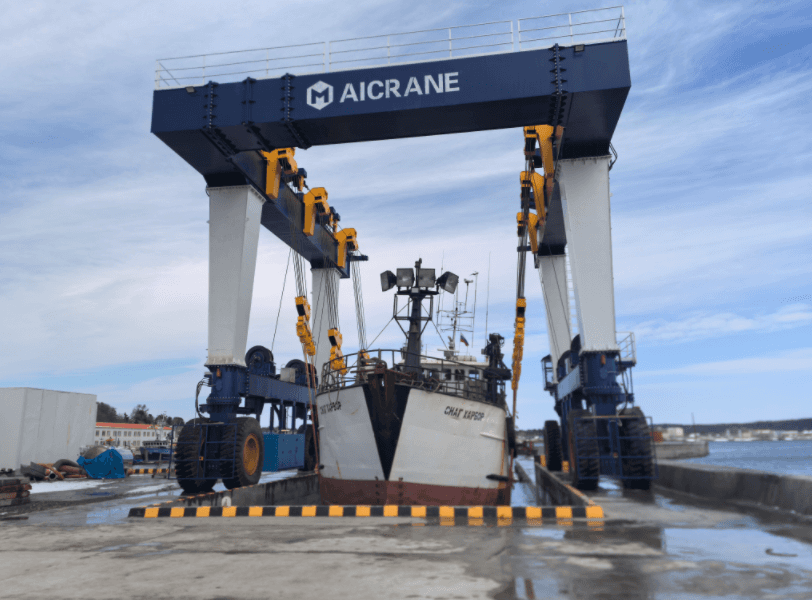
In modern shipyards, marinas, and boat maintenance facilities, boat travel lifts play a critical role in safely hauling, transporting, and launching vessels of various sizes. Whether handling a 10-ton fishing boat or a 500-ton commercial vessel, one engineering challenge remains constant: maintaining load balance throughout the lifting process.
An unbalanced lift can lead to hull deformation, excessive structural stress, sling slippage, operational instability, and even serious safety incidents. This is why hydraulic systems are designed not only to generate lifting force but also to continuously monitor, equalize, and control load distribution.
This article explains how boat travel lift hydraulic systems maintain load balance and why hydraulic synchronization technology has become one of the most important features in modern marine lifting equipment.
Why Load Balance Matters in Boat Travel Lifting
Unlike standardized industrial loads, boats and yachts rarely have perfectly symmetrical weight distribution.
Factors affecting load balance include:
Engine room location
Fuel tank placement
Water tanks and ballast systems
Hull geometry
Superstructure weight
Equipment installed onboard
As a result, the vessel's center of gravity often differs from its geometric center.
When a boat travel lift begins lifting a vessel, each sling may experience different loading conditions. Without proper balancing control, one side may rise faster than another, creating:
Hull twisting forces
Uneven stress concentrations
Sling movement
Vessel listing
Increased risk of structural damage
The hydraulic system is therefore responsible for ensuring that all lifting points work together as a coordinated system rather than as independent lifting mechanisms.
The Hydraulic Foundation of Load Balancing
Boat travel lifts rely on hydraulic power because hydraulic systems can generate enormous lifting forces while maintaining precise control.
The principle behind hydraulic lifting is based on Pascal's Law, where pressure applied to a confined fluid is transmitted equally throughout the system. This allows relatively small control inputs to generate substantial lifting forces. Modern travel lifts use hydraulic pumps, cylinders, valves, hoses, and electronic controls to convert hydraulic pressure into synchronized lifting motion.
However, generating lifting force is only the first step.
The greater challenge is ensuring that multiple lifting points rise at the same rate while supporting an uneven load.
Multiple Hydraulic Cylinders Working Together
A typical boat travel lift utilizes several hydraulic cylinders positioned throughout the lifting structure.
Each cylinder contributes to:
Sling elevation
Load support
Position control
Load-sharing functions
If these cylinders operated independently, even minor differences in oil flow, pressure, friction, or component wear could cause uneven movement.
Industrial hydraulic systems have long recognized that unsynchronized cylinders can create frame distortion, binding, and structural stress. For this reason, modern lifting equipment incorporates synchronization controls to coordinate cylinder movement.
The goal is simple:
Every lifting point must move in a controlled and predictable manner regardless of the load applied to it.
Hydraulic Flow Equalization
One of the primary balancing methods involves hydraulic flow equalization.
The hydraulic pump delivers pressurized oil to the lifting cylinders through carefully designed circuits. Flow control valves regulate how much hydraulic fluid reaches each cylinder.
When one side of the vessel carries a heavier load, the system automatically compensates by adjusting oil flow and pressure.
This helps maintain:
Equal lifting speed
Consistent sling elevation
Controlled vessel attitude
Many marine hydraulic lifting systems employ synchronized hydraulic cylinders that receive equal hydraulic volume during operation, helping keep the load level throughout the lifting cycle.
Without this balancing mechanism, even a small speed difference between cylinders could become magnified during a full lifting operation.
Pressure Monitoring and Load Sharing
Pressure monitoring is another essential component of load balancing.
Each hydraulic cylinder experiences pressure proportional to the load it supports.
Modern travel lifts continuously monitor:
Cylinder pressure
Hydraulic circuit pressure
Load distribution across lifting points
Pressure differentials
By comparing these measurements, the control system can determine whether one sling is carrying excessive weight.
If imbalance occurs, corrective actions may include:
Reducing flow to a lightly loaded cylinder
Increasing pressure to a heavily loaded cylinder
Adjusting lifting speed
Alerting the operator
This load-sharing capability helps prevent overload conditions and improves overall lifting safety.
Electronic Synchronization Systems
Traditional hydraulic systems relied primarily on mechanical balancing and operator experience.
Today's boat travel lifts increasingly utilize electro-hydraulic synchronization systems.
These systems integrate:
Position sensors
Pressure sensors
Programmable Logic Controllers (PLC)
Electronic feedback loops
The controller continuously receives data from multiple lifting points and calculates whether all cylinders are moving at the required speed.
If a deviation is detected, the system automatically adjusts hydraulic flow rates to restore synchronization.
Modern travel lift control systems commonly monitor:
Cylinder position
Pressure levels
Load distribution
Lifting height
These measurements provide real-time feedback that enhances balancing accuracy and operational safety.
The result is significantly improved lifting precision compared with older manually controlled systems.
Load Equalization During Sling Tensioning
Load balancing begins before the vessel actually leaves the water.
During the initial sling tensioning stage, operators gradually apply hydraulic pressure until all slings make contact with the hull.
This phase is critical because:
Hull shapes vary considerably
Sling locations differ between vessels
Weight distribution is not yet fully known
The hydraulic system applies pressure gradually, allowing operators and sensors to identify load imbalances before full lifting begins. Modern lifting procedures typically include an initial engagement phase where hydraulic cylinders slowly take up slack and establish controlled contact with the vessel before synchronized lifting starts.
By balancing sling loads early, the risk of sudden load transfer during lifting is reduced.
Real-Time Dynamic Adjustment
Load balance is not a static condition.
As the vessel leaves the water, several factors may change:
Water buoyancy decreases
Hull support points shift
Vessel movement affects load distribution
Sling angles change
Consequently, hydraulic systems must continuously adapt throughout the lifting cycle.
Modern travel lifts perform dynamic load balancing by:
Continuously reading sensor data
Comparing actual versus target positions
Adjusting hydraulic flow in real time
Maintaining synchronized lifting speeds
This closed-loop control approach enables the system to respond instantly to changing load conditions.
Safety Systems That Support Load Balance
Load balancing is closely linked to overall safety.
Modern hydraulic travel lifts incorporate multiple protective functions, including:
Overpressure Protection
Pressure relief valves prevent excessive hydraulic pressure from damaging cylinders or structural components.
Load Monitoring Systems
Continuous load measurement helps operators identify abnormal weight distribution before dangerous conditions develop.
Emergency Stop Functions
Operators can immediately halt lifting operations if significant imbalance occurs.
Automatic Fault Detection
Control systems can detect sensor failures, hydraulic leaks, or synchronization errors and trigger alarms.
Together, these systems create multiple layers of protection against imbalance-related incidents.
The Future of Hydraulic Load Balancing
The marine lifting industry continues to adopt smarter balancing technologies.
Emerging innovations include:
AI-assisted load prediction
Digital twin simulation
Advanced PLC control architectures
Remote diagnostics
Predictive maintenance systems
Integrated vessel weight databases
Future travel lifts may automatically calculate optimal sling positions, predict load distribution before lifting begins, and continuously optimize hydraulic performance during operation.
These developments will further improve safety, efficiency, and reliability for shipyards handling increasingly diverse vessel types.
Conclusion
Maintaining load balance is one of the most important functions of a boat travel lift hydraulic system. While hydraulic power provides the lifting force, true operational safety depends on how effectively that force is distributed across multiple lifting points.
Through synchronized hydraulic cylinders, flow equalization, pressure monitoring, electronic feedback control, and real-time load sharing, modern boat travel lifts can safely handle vessels with complex and uneven weight distributions. These technologies work together to minimize hull stress, improve lifting precision, and reduce operational risk.
As marine lifting equipment continues to evolve, hydraulic load balancing systems will become even more intelligent, helping shipyards achieve safer vessel handling, greater efficiency, and higher levels of operational confidence.