Gantry Crane
RTG Crane Solutions for Precast Concrete Yards: Optimizing Load Distribution for Heavy Beams
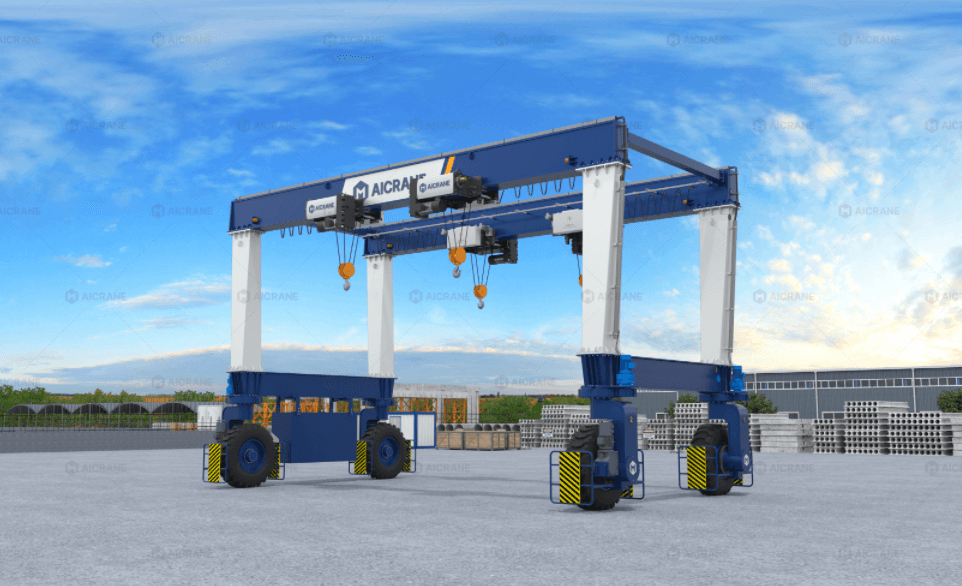
Precast concrete production relies heavily on efficient material handling systems. In large-scale precast yards, heavy beams, bridge girders, wall panels, pipes, and structural components must be transported safely and accurately between casting areas, curing zones, storage yards, and loading positions. Among the various lifting solutions used in this industry, Rubber Tyred Gantry (RTG) cranes have become one of the most practical and flexible options for handling oversized concrete beams and long-span structural elements.
Unlike fixed rail-mounted systems, RTG cranes offer mobility, adaptable routing, and the ability to operate across multiple work areas without requiring permanent track installation. However, handling precast concrete beams presents unique engineering challenges. These loads are not only extremely heavy, but also long, unevenly distributed, and highly sensitive to improper lifting forces. Poor load distribution can lead to beam cracking, structural deformation, crane instability, excessive tire loading, and unsafe handling conditions.
For precast concrete yards aiming to improve productivity while maintaining operational safety, optimizing load distribution is one of the most important aspects of RTG crane system design.
Why Load Distribution Matters in Precast Beam Handling
Precast concrete beams often differ significantly from standard industrial loads. Their dimensions may exceed 20 meters in length, and their center of gravity is not always perfectly balanced. During lifting and transportation, uneven force distribution can create several operational problems:
Excessive bending stress on the concrete beam
Uneven wheel pressure on the RTG crane
Increased risk of tire overloading
Crane frame torsion and structural fatigue
Reduced lifting stability during travel
Swing and vibration during acceleration or braking
Unlike steel structures that may tolerate certain levels of deformation, precast concrete components are more vulnerable to cracking under improper lifting conditions. Even minor imbalance during transportation can damage finished products and increase rejection rates.
Because of this, RTG crane systems used in precast yards must be engineered with both crane stability and load integrity in mind.
Key Design Considerations for RTG Crane Load Distribution
Structural Frame Rigidity
The structural rigidity of the RTG crane frame directly affects load distribution performance. When transporting heavy precast beams, uneven stress across the gantry structure can lead to frame twisting and unequal wheel loading.
To minimize this risk, precast RTG cranes are commonly designed with:
Double girder gantry structures
High-strength steel fabrication
Reinforced saddle sections
Optimized leg geometry
Finite element analysis (FEA)-based stress verification
A rigid crane structure helps ensure that lifting forces remain evenly distributed across all wheel assemblies during lifting and traveling operations.
For large-span beam handling applications, box girder designs are often preferred because they provide improved torsional resistance compared to truss-type structures.
Multi-Point Lifting Configuration
One of the most effective ways to optimize load distribution is through multi-point lifting systems.
Instead of lifting a long precast beam from a single central hook, RTG cranes typically use:
Dual hoist systems
Multiple lifting points
Equalizer beams
Spreader frames
Synchronized hoisting mechanisms
These configurations help distribute the beam weight more evenly across the lifting structure.
For example, when lifting a prestressed concrete bridge girder, two synchronized hoists positioned at calculated lifting points can reduce bending moments significantly. This minimizes internal stress within the beam while improving crane stability.
In many modern precast yards, PLC-controlled synchronized lifting systems are used to ensure that both hoists maintain identical lifting speeds and load sharing ratios throughout the lifting cycle.
Tire and Wheel Load Balancing
Because RTG cranes operate on rubber tires rather than rails, tire load distribution becomes a critical engineering factor.
Improper weight distribution can create:
Uneven tire wear
Excessive ground pressure
Reduced travel stability
Steering difficulties
Higher maintenance costs
To address this, RTG cranes for precast yards are commonly equipped with:
Hydraulic load equalization systems
Multi-wheel bogie assemblies
Independent suspension compensation
Electronic wheel pressure monitoring
The goal is to maintain relatively uniform wheel loading, even when traveling across uneven yard surfaces.
In heavy beam applications, some RTG cranes use 8-wheel, 16-wheel, or even 32-wheel configurations to spread the total load over a larger ground contact area. This is especially important in temporary precast yards where pavement strength may be limited.
Ground Conditions and Surface Stability
Load optimization is not only related to the crane itself. Ground conditions within the precast yard also play a major role.
When transporting extremely heavy beams, weak pavement sections or uneven surfaces can shift load distribution unexpectedly. This may cause one side of the crane to experience significantly higher wheel pressure than the other.
To improve operational safety, precast yards should evaluate:
Soil bearing capacity
Concrete pavement thickness
Surface flatness tolerances
Drainage conditions
Settlement risks
In many projects, crane travel paths are reinforced specifically for heavy beam transportation routes.
Some advanced RTG systems also integrate automatic leveling systems that compensate for slight surface irregularities during movement.
Anti-Sway Technology for Beam Stability
Long concrete beams are highly sensitive to swing during lifting and travel operations. Sudden motion can create dynamic load shifts that negatively affect load distribution.
Modern RTG cranes increasingly use anti-sway systems to improve handling precision.
These systems may include:
Variable frequency drive (VFD) motion control
Sway angle sensors
PLC-based trajectory control
Automatic acceleration and deceleration optimization
Real-time load monitoring
By reducing beam oscillation, the crane can maintain more stable wheel loading and safer travel conditions.
This is especially important in precast yards where multiple cranes, storage racks, and production lines operate simultaneously within limited space.
Optimizing Beam Storage and Yard Layout
Efficient load distribution also depends on proper yard planning.
In poorly organized precast yards, RTG cranes may be forced to perform excessive turning, diagonal movement, or uneven lifting operations. These movements can increase structural stress and reduce operational efficiency.
Optimized yard layouts typically focus on:
Straight travel routes
Minimized turning radius
Balanced storage lane spacing
Dedicated beam transport corridors
Clearly defined lifting zones
By reducing unnecessary crane maneuvers, operators can maintain more predictable load distribution throughout the handling process.
Intelligent Monitoring Systems
Modern RTG cranes for precast concrete yards increasingly integrate intelligent monitoring technologies.
These systems help operators identify load distribution problems before they become safety hazards.
Common monitoring functions include:
Real-time wheel load detection
Crane inclination monitoring
Hoist synchronization feedback
Wind speed monitoring
Structural stress monitoring
Tire pressure monitoring
Some advanced systems also provide automatic overload alarms and operational recommendations based on live crane conditions.
With digital monitoring, precast yard operators can improve preventive maintenance while reducing the risk of beam damage and crane instability.
Energy Efficiency and Operational Optimization
Efficient load distribution can also improve crane energy performance.
When weight is unevenly distributed, crane motors and travel systems must compensate for additional resistance and instability. This increases power consumption and accelerates component wear.
Optimized RTG crane systems can improve efficiency through:
Balanced wheel loading
Smooth travel control
Regenerative braking systems
Lightweight structural optimization
Intelligent motion path control
For large precast yards operating multiple cranes daily, these improvements can significantly reduce long-term operational costs.
Safety Considerations in Heavy Beam Handling
Safety remains one of the most important priorities in precast concrete operations.
Heavy beams present elevated risks due to their size, weight, and structural sensitivity. RTG crane systems must therefore incorporate multiple safety protections, including:
Overload protection systems
Emergency stop functions
Anti-collision systems
Wind protection devices
Travel limit protection
Redundant braking systems
Load imbalance alarms
Operator training is equally important. Even advanced RTG systems require experienced personnel who understand beam lifting dynamics, load center positioning, and safe travel procedures.
Many precast yards now combine automation with manual supervision to achieve both efficiency and operational control.
Future Trends in RTG Crane Solutions for Precast Yards
As precast construction projects become larger and more automated, RTG crane systems are continuing to evolve.
Several trends are shaping the future of heavy beam handling:
Automation and Remote Operation
Remote-controlled and semi-automated RTG cranes are becoming increasingly common in large precast facilities. These systems improve positioning accuracy while reducing operator fatigue.
Digital Twin Technology
Some manufacturers are introducing digital twin systems that simulate crane behavior and load distribution under real operating conditions. This allows engineers to optimize crane performance before deployment.
Lightweight Structural Engineering
Advanced steel materials and optimized structural designs are helping reduce crane self-weight while maintaining high load capacity.
Smart Predictive Maintenance
Sensor-based predictive maintenance systems help identify abnormal wheel loading, structural stress, and component wear before failures occur.
Sustainable Yard Operations
Electric RTG cranes and hybrid power systems are becoming more popular as precast yards seek to reduce emissions and energy consumption.
Conclusion
RTG cranes play a critical role in modern precast concrete yards, especially in applications involving large bridge girders, heavy beams, and oversized structural components. However, successful beam handling depends far more on engineering optimization than on lifting capacity alone.
Proper load distribution affects every aspect of crane operation, including structural stability, beam safety, tire loading, energy efficiency, and long-term equipment reliability.
By integrating rigid structural design, synchronized lifting systems, balanced wheel configurations, intelligent monitoring, anti-sway technology, and optimized yard layouts, precast concrete producers can significantly improve both operational safety and production efficiency.
As precast construction continues to expand globally, RTG crane systems will remain an essential solution for handling increasingly large and complex concrete components in demanding industrial environments.